Wednesday, 2 October 2013

After jury realization

The day after the jury, we figured what to do next based on the feedback given to us. So we mapped the opportunities we could see.


Praveen also defined for us the possible forms of deliverables.


And to add to that, we made ourself check lists (not exhaustive) for our project, to be able to assess our ideas objectively.


..And then went on to putting our ideas on paper.

There were some from the administrative point of view:


Some in-courtroom solutions:


Others from the point of view of the litigant:


And a couple of random ones!


Saturday, 21 September 2013

The jury. Or somewhat so!

This Thursday morning until Friday afternoon, we had a peer to peer feedback session on our progress so far. In a three member panel, we each became a jury member equal to another group!


Though we smiled about it at first, it worked out pretty well by the end. The feedback was detailed, critical and helpful.


First of all, it was not just our own group feedback that rung the bell in our heads. Even while we sat for others, we realized very important things. For instance, we hadn't, so far, penned down our Vision Statement. What is it that we are trying to do ultimately? Of course, we had thought about it now and then, but never so seriously to define it.


So once we got down to it, we figured that in the whole Judicial System, the most important person is the Litigant. It's his problem and his right to get justice. All the others in the way; the lawyers, the judges, the staff; they're all simply facilitators. So we defined our Vision Statement to making it easier and quicker for the litigant to get justice; to reduce his unnecessary anxiety and make his entire experience less taxing. Why should he have to go through so much trouble just to get what he must rightfully have?

On the same lines, there were other points that came up in the discussion. There is always fear of something that we do not know about. So since people don't know about the working of the Judiciary, they're afraid of getting stuck in it. And clearly, we don't remember any of our civics lessons well enough that they be of any assistance. And one fine day you realize you're in the middle of the hassle and have no idea whatsoever how to go about it. So at what age and stage, and how must one be taught about this system? How can one be made aware enough that one loses the fear of it?

The whole process needs to be more user centric. It's not about you but about the system right now, whereas, reiterating, it is in fact the litigant who should be in the centre of things. 

The information must be accessible as and when one needs it and not so much earlier that one forgets it. Must the constitution be more readily available as well as easier to comprehend? Or will more information be more harmful than beneficial?

How can one deal with the active and passive waits? (In this case, the former would be when one is waiting for the next hearing, or other court procedures, and the latter when one's case hearing is going on, for instance. For more interesting insights on this subject, see another systems project from our class on waiting: http://waiting365.wordpress.com/ ) Is there a way to deal with the user's anxiety? There is a certain amount of satisfaction that one gets from knowing what is going on in something that one is involved in. Can there be a progress bar to quantify the process?

So one of the important suggestions was that because we are trying to keep the litigant as our point of focus, we can try to follow one case from start to end and talk to more litigants, and then use empathy tools, which is something we haven't been doing so religiously so far.

We also have to see that in the whole process, the stakeholders must not feel less important. The emotions, the human touch; they all have to be taken care of. ("Mera case hai. Achchhe se hona chahiye.")

Another suggestion was to study the Panchayat System as another self sufficient establishment. We hadn't done that beyond our knowledge from school level civics (which I have already mentioned we don't remember much of!)


Can popular media be used as a powerful tool to affect the system? Could and should the judges be linked to the litigants? What kind of an incentive can be given to the stakeholders to WANT to speed up the process? Will the jury system be better for India? If not, why?

These were some questioned that were still unanswered.

Trying to save ourselves from drowning in this pool of questions, at 4 am on a Sunday morning, this is Prithvi and Shivani, signing out to get some sleep.

But why the Judiciary??

So where were we? Oh yes! That one fine night when we questioned; why is the judicial system there as it is today? What was the whole point? The need? When you and your friend/your enemy/a stranger have a fight, you'd rather listen to a third person who you've never met or spoken to before and let them decide for you than settle matters among yourselves. Why is that so acceptable, even comforting?


So, we thought it's possibly human nature to want a Social hierarchy and Rules (please excuse the spelling error and dumb drawings!). That's how it's always been. There are kings, dictators, teachers, parents, judges, policemen, priests and many more who have always been higher in the social hierarchy, and then there are rules always guiding you. Religious rules. Parental rules. Democratic Rules. Moral rules (Ethics?).Traffic rules! And without them, there will be chaos.

At some point, they also collide because you want rules to bring about equality, so that everyone follows the same, and then you also want people to execute and enforce the rules, thus bringing them on another social level, thus breaking the equality you wanted in the first place!

So, if this human trait is the need of this whole system, and suppose this system was never there, what could we come up with? A completely different alternative? I'm sure it's as crazy and complicated as it sounds, or more. But it sounds like a logical systemic way to think of this whole problem. Is there more we are missing out on? Where do we begin when we've landed right back into that endless sea that we tried to narrow down from three weeks back?

We thought. We talked. We saw.

With those initial ideas in mind, we started speaking to people; people inside the system or related to it. So that included quite a few phone calls along with a couple of more visits; to GNLU, to the High Court, and more.

So as we had already mentioned previously, our ideas so far were from inside the system, incremental mostly with the aid of technology, and then from the outside to assist the litigant, like the call centre idea. Now the funny part was that while on one hand, we were told that for reasons like the subjectivity of legal advice and the liability that would follow it, a call centre would not work, on the other we discovered that there was already a legal helpline in Gujarat under their Legal Services Authority of the State.


Above is, in short, how the Gujarat legal helpline functions from their office in Shahibagh, Ahmedabad. It runs along with the Legal aid and ADR, so together it can assist the litigant in a variety of ways.


So then we thought we could take the rough model of Gujarat and alter and improve it to fit another state with problems on a much higher level.

But then, one fine night, it dawned upon us...

The beginning of solutions, systematically enough?

Inspiring as they were, the existing systems ended up bringing out some pretty interesting points.


We had started building more connections. So it started off by mapping the system, then finding faults and finally picking out some of them and trying to find solutions with the help of other systems.

..As the spread increased..


..A lot more inter-connections came out..

..And we started recognizing stakeholders involved at each of the points.

The two perspectives that we started looking from were:
One, from inside the Judicial System, and
Two, from the outside, from the litigant's point of view.

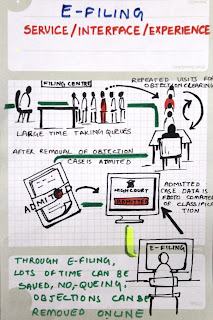
In the former, we looked at a few incremental solutions based on measures that were already being taken to speed up courtroom and administrative processes. For example, computerization has already been taking place for a while now. They will probably digitize the process of filing also sooner or later and make the process paperless. (If not, well, we could recommend that too! But there will be some amount of getting used to required before people will be open to so much technology.)

But technology is not our solution. In this case, we are trying to look at making the best of what is already being provided. So, if filing be digitised, can changes be managed from the office of the lawyer. That'll save a few visits back and forth and make things faster and more convenient.


Can adjournments be managed before cases reach the court? (Above is a small model of how it could work out) That should save some time in the courtroom.


If they are already planning to set up E-courts, how well can one harness the potential of the screen? A common one, or personal screens for the judge/s and the lawyer/s? Can navigation through case files be made faster? Or will it be detrimental? May be a few quick pointers will help the judgement; like the number of adjournments that have already been taken in a case might help the judge decide whether to give another one or not. What kind of information can assist the judgement of a judge? With so many cases in a day, how can one reduce the cognitive load on a judge?


On the other hand, when we started looking at it from the litigants' point of view, there came the question of how much information do they want, and how much do they need to make their experience less anxious and more easy. They must not be cheated at any stage either. So we started juggling on the idea of a call centre for the Judiciary. Taking inspiration from how in Passport Seva Kendra, the incorporation of a call centre made things much more transparent and the middlemen then became only and only middlemen who did their jobs without being able to change the clients exorbitantly.

In a lot of states, cases can easily be tracked online, but clients still call their lawyers or clerks to ask for the status of the case. It is because internet is still a luxury for a good part of the population. If there is a means of communication that is at everyone's disposal, it is the phone. Everyone from the village to the metropolitan has access to a phone, and in most cases, their own mobile phone.

So it sounded sensible to tap into this mode of communication, and then not just for tracking. One could take legal advice, could be suggested to go for Alternate dispute resolution to redirect cases from going to court, or could even be explained the process of the court to be able to represent oneself, which is one's right. It could be channelized either through the State Legal Aid, or the Information Centre in Courts.

That's what came to our mind till last week, and then we spoke to some people.

Friday, 6 September 2013

Let's get inspired

After understanding and questioning our own System, it was time to see the keys to success of other systems. What makes them so special, and what is it that we are missing?


Parallel Judicial Systems in other countries where technology has played an important role in speeding up the processes. There are High Tech Courtrooms in Virginia having flat screen displays, which makes evidence presentation electronic along with making it more convenient for remote and secluded witnesses to appear. Computerization of records has proven to prevent long delays because files don't go missing. This has been successfully helpful in several Indian courts as well.
Michigan courts have a Judicial Information System (JIS) that makes collection and dissemination of information automated and efficient. Case flow management allows timely disposition of cases by keeping track of time. Access to information is quick and easy. Summons can be printed. They have even incorporated the bar code technology. Along with that, traffic tickets can be paid online, which is automated, convenient and saves the time of a lot of court staff.


Both Passport Seva Kendra and VFS use outsourcing to enhance their efficiency. Digitisation of application, tracking and verification has made the whole process transparent, streamlined and simple.
Aravind Eye Care, on the other hand, has been inspired by the assembly line process, like in the case of Mc Donald's, which makes it highly efficient and cost-effective. Everyone does only and only what they are supposed to do and what they are good at doing. They use camps to spread awareness and use the local community's support.
All the three systems above facilitate the general public with services in a very efficient way, which is what we are trying to achieve in the Judicial sector.


World cafe is an interesting concept where they provide a hospitable space to host collaborative dialogue and international opinions on questions, and then share collective discoveries. We thought this was somewhat similar to initiatives like change.org, except in a physical form, where you pose a question, gather opinions and share insights, though the first is driven by a clear, strong motion to change something.
Toyota was inspiring because of its supply demand management, where they only produce when there is demand and save on money and stock storage space. Plus, there is no waste.
Mc Donald's, apart from it's successful assembly line production technique, gives the customer access to information so he can make an informed decision about what he eats.

There are a few more which we haven't charted down yet, but there's endless information out there, which we must keep absorbing. Right now, it's time to build some analogies. They're working their way in our heads, but give us some time to formulate them. Let's get back to you in our next post. Till then, any ideas are more than welcome.